
Adults at risk (previously Vulnerable Adults)
Individuals want to live rich and fulfilling lives, participating in their local community and contributing to its vibrancy. Families want this for their loved ones too.
They, and society at large, also want to ensure that those who need care and support – whether a young learning-disabled person or a 90 year-old with dementia – are supported in ways which enable them to feel safe, happy and where possible to take part in the life of their community.
Vulnerable Adult/Adult at risk
In adult social care (England/UK context), an “adult at risk” (previously referred to as a “vulnerable adult”) is someone aged 18+ who may need care and support and is unable to protect themselves from harm, abuse, or neglect.
A key point is that vulnerability is not just about a condition - it’s about the interaction between a person’s needs and their ability to stay safe.
Important safeguarding definition Care Act 2014
An adult is considered “at risk” if they:
- Has needs for care and support
- Is experiencing or at risk of abuse or neglect
- Is unable to protect themselves because of those needs
Key groups who may be considered vulnerable/at risk
People with physical disabilities
- Mobility impairments
- Chronic illness (e.g. multiple sclerosis, Parkinson’s)
- Frailty (e.g. due to age)
People with learning disabilities
- Mild to profound learning disabilities
- Conditions affecting understanding, communication, or decision-making
People with mental health needs
- Severe mental illness (e.g. schizophrenia, bipolar disorder)
- Depression or anxiety impacting daily functioning
Older adults (especially with increased dependency)
- Frailty or age-related conditions
- Dementia (Alzheimer’s, vascular dementia)
People with sensory impairments
- Visual impairment (partial sight or blindness)
- Hearing loss or deafness
People with cognitive impairment
- Brain injury (acquired or traumatic)
- Dementia or other neurological conditions affecting thinking and memory
People with substance misuse issues
- Alcohol dependency
- Drug misuse that affects judgement, health, or safety
People experiencing social exclusion or instability
- Homelessness or insecure housing
- Isolation (little or no social support)
- Refugees or migrants with additional vulnerabilities
People at risk due to abuse or exploitation
- Domestic abuse survivors
- Victims of financial exploitation, coercion, or manipulation
- Modern slavery or trafficking victims
People who cannot protect themselves
- This is a key principle. Regardless of diagnosis, someone may be vulnerable if they:
- Struggle to understand risks
- Cannot communicate concerns
- Depend heavily on others for care/support
All children are considered vulnerable by virtue of their age and immaturity, but which adults can be considered ‘vulnerable’?
Many people think of adults as being vulnerable if they’re permanently or temporarily unable to care for themselves and their interests, either through a mental or physical cause.
Vulnerable adults are open to risks of psychological and physical harm or being exploited for other people’s benefit.
The following groups of people could be considered as ‘vulnerable adults’:
- older people who are physically or mentally frail
- people with learning disabilities
- people with a mental health condition such as dementia or personality disorder
- people who are ill and need help to carry out normal daily functions
- people with physical disabilities
- people who have undergone a recent trauma – a bereavement, a divorce or loss of a job, for instance
- people who, for whatever reason, are in abusive relationships or are homeless.
But care needs to be taken about who are considered ‘vulnerable’. Just because someone is, for instance, older, or has a mental health condition or a learning disability, or has a physical disability, they are not necessarily ‘vulnerable’. Indeed, they may take great offence if you were to consider them so. Everyone needs to be wary of applying ‘labels’ to the people in our care.
it is also important to recognise that being vulnerable isn’t necessarily a long-term state. People who come into hospital for operations, for instance, will be very vulnerable immediately before, during and after the operation when they are not able to care for themselves and rely on health care staff to protect them and ensure their well-being. But in the vast majority of cases they will soon be completely independent again, so the vulnerable state is only temporary.
Social Care and supporting local residents
Individuals want to live rich and fulfilling lives, participating in their local community and contributing to its vibrancy. Families want this for their loved ones too.
They, and society at large, also want to ensure that those who need care and support – whether a young learning-disabled person or a 90 year-old with dementia – are supported in ways which enable them to feel safe, happy and where possible to take part in the life of their community.
Those who work in or receive adult social care services recognise this. This is the core social purpose of care and support – not to control people’s lives for them but to work with them as equal partners to help them achieve what they want from life.
The vision and aims of the Government’s White Paper, Caring for our future (2012) include:
- Choice and control
- Working in partnership
- Personalised care
- Keeping people healthy and involved with their communities
Social care (‘care’) comprises personal care and practical support for adults with physical disabilities, learning disabilities, or physical or mental illnesses, as well as support for their carers.
Adults’ care needs are often multiple and interrelated with other needs. Adult social care is therefore part of a complex system of related public services and forms of support.
How well services meet adults’ needs depends on all parts of the system working together. For example, good medical management of long-term conditions can prevent a person developing care needs, and welfare benefits can maintain independent living.
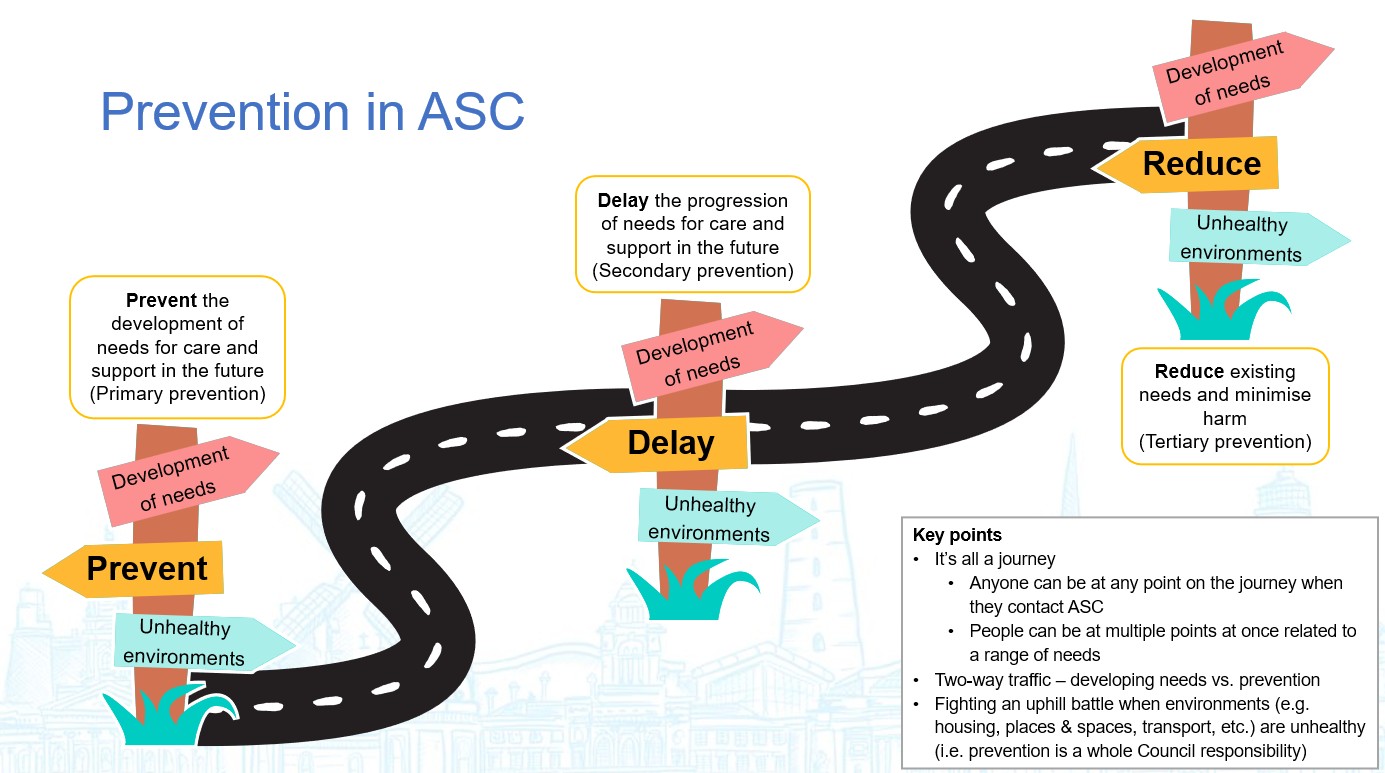
Prevent, delay, reduce...
The Care Act 2014 places a duty on local authorities to prevent, delay, and reduce needs for care and support. This duty is part of the broader aim of promoting wellbeing and independence, not just waiting for a crisis point to respond.
The Care and Support Statutory Guidance outlines how local authorities should fulfill their responsibilities, which apply to all adults, including carers.
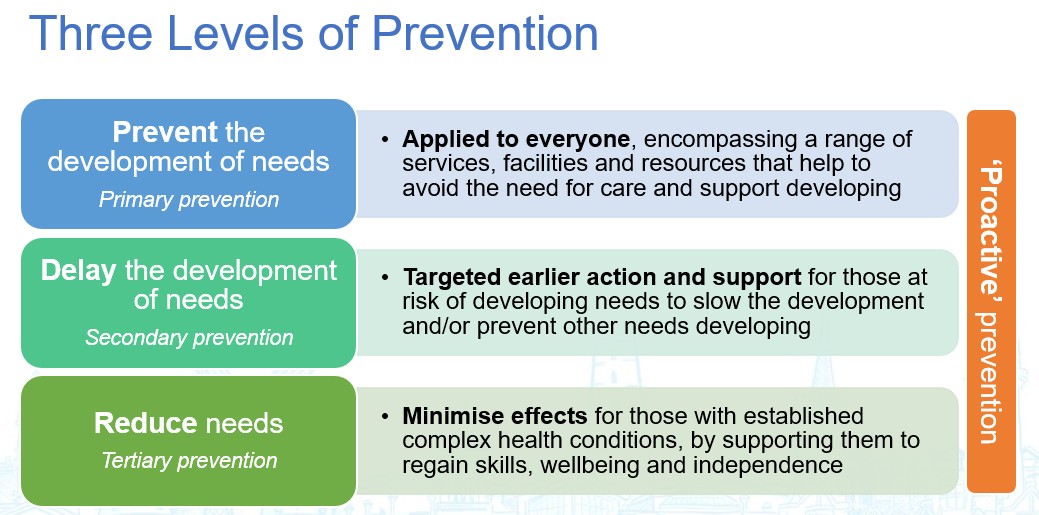
The term 'prevention' encompasses various types of support, services, facilities, and resources, ranging from whole population measures to individual interventions. It is often broken down into three general approaches: primary, secondary, and tertiary prevention.
These approaches aim to help individuals avoid developing care and support needs or help carers avoid developing support needs by maintaining independence and promoting wellbeing.
Prevent – primary prevention/promoting wellbeing
- This approach should be applied to everyone, encompassing a range of services, facilities and resources that will help avoid the need for care and support developing.
- It could include information and advice, promoting healthy and active lifestyles, and reducing loneliness and isolation.
Reduce – secondary prevention/early intervention
- This approach is targeted at individuals at risk of developing needs where support may slow this process or prevent other needs from developing.
- It could include carer support, falls prevention, housing adaptations or support to manage money.
Delay – tertiary prevention/formal intervention
- The third approach is aimed at people with established complex health conditions, to minimise the effects, support them to regain skills and to reduce their needs wherever possible.
- This could include rehabilitation/reablement services, meeting a person’s needs at home, and providing respite care, peer support, emotional support and stress management for carers.
Local Approach
Local approach to prevent, delay, reduce...
We are currently developing our local Wirral Adult Social Care Prevention Strategy "Making Prevention Everyone’s Business" (2026 - 2028). We expect this to be published by Summer 2026).
Prevention Strategy (2026) (In development - publication very soon)
The Council and partners is developing an Adult Social Care Prevention Strategy (Summer 2026) and progressing work through a Prevention Task and Finish Group focused on unpaid carers, social isolation and reablement.
This has been developed in partnerships with Public Health and aims to strengthen the already published Prevention strategy for Wirral Council.
The Adult Social Care prevention strategy is supported by wider transformation activity to improve the use of integrated data to identify need earlier and target preventative support effectively.
Work underway: Developing our knowledge and insight
This section will be updated in coming weeks and months with specific insight and intelligence that supports the work and development of the Prevention Strategy.
Approach to prevent - delay - reduce
Data and Insight
The use of data and insight should not be optional - it is fundamental to improving outcomes for vulnerable adults and adults at risk.
A strong data and insight approach:
- Improves understanding of need and risk
- Enables early intervention and prevention
- Supports better decision‑making and targeting of resources
- Strengthens safeguarding, accountability, and assurance
- Promotes integration, equity, and sustainability
Data and insight translate intent into impact, ensuring that policy, commissioning, and practice are grounded in evidence and focused on what makes the greatest difference to people’s lives.

Local Evidence and Insight
Headlines
In terms of need in Wirral, emerging findings show that, compared to England and the North West:
- Self-reported disability is higher
- More people have long-term conditions that seem to be presenting earlier in life
- Sight impairment and preventable sight loss are higher
- Fewer ASC clients are free of pain or discomfort, but more are on prescribed painkillers
- Fewer ASC clients are free of anxiety or depression
- Wirral has more unpaid carers but half are flagged as such with their GP, and many of their outcomes need improving
- Wirral has more private renters aged 65+, with more older people living in single person households
- Fewer ASC clients and carers feel they have enough social contact
- Wirral has more fuel poverty, PIP claimants, and Housing Benefit claimants
In terms of demand in Wirral, emerging findings show that, compared to England and the North West:
- New requests for ASC are higher, both for those aged 18-64 and those aged 65+
- Short-term care has been falling while long-term care has been increasing
- The primary support reason for more than 70% of ASC clients in both long- and short-term care is physical health; this is higher than England and the North West
- Wirral provides more long-term care in the community
- New admissions to residential or nursing care homes of people aged 18-64 are higher
- Those aged 65+ see a higher rate of residential placements and a lower rate of nursing home placements
Adult Social Care Outcomes Framework (ASCOF)
The Adult Social Care Outcomes Framework (ASCOF) measures how well care and support services achieve the outcomes that matter most to people. The ASCOF is used both locally and nationally to set priorities for care and support, measure progress and strengthen transparency and accountability.
Public Health Outcomes Framework (PHOF)
View Wirral data and insight on PHOF
The Public Health Outcomes Framework (PHOF) sets out a vision for public health. Its aim is to:
- improve and protect the nation's health
- improve the health of the poorest fastest
The framework focuses on the two high level outcomes we want to achieve across the public health system and beyond:
- Increased healthy life expectancy.
- Reduced differences in life expectancy and healthy life expectancy between communities.
Our focus is on reducing differences between people and communities from different backgrounds. This is not only for life expectancy, but also for healthy life expectancy.
LGInform reports
Adult Social Care Priorities for Local Authorities: A Focus on Wirral (June 2026)
Web version and document
Public Health Intelligence evidence
In development (June 2026)
- Asylum Seekers and Refugees
- Hearing Impairment
- Literature review: The approaches of other Local Authorities to adult social care prevention activity
On website
-
Child & Family Poverty - Wirral Health and Wellbeing Knowledge Hub
-
Disease Profiles - Wirral Health and Wellbeing Knowledge Hub
-
Eye Health (Adult) - Wirral Health and Wellbeing Knowledge Hub
-
Falls (Older People) - Wirral Health and Wellbeing Knowledge Hub
-
Health Inequalities - Wirral Health and Wellbeing Knowledge Hub
-
Learning Disabilities - Wirral Health and Wellbeing Knowledge Hub
-
Social Isolation & Loneliness - Wirral Health and Wellbeing Knowledge Hub
-
Sexual and Reproductive Health - Wirral Health and Wellbeing Knowledge Hub
-
Wirral Indices of Deprivation - Wirral Health and Wellbeing Knowledge Hub
Local Evidence and Insight Tools
Wirral Health and Wellbeing Knowledge Hub
Our website presents a collection content that provides the broadest picture of Wirral residents.
From population and demographic reports to detailed JSNA assessments and everything in between.
Visit Wirral Health and Wellbeing Knowledge Hub for more information
Wirral Local Insight
Local Insight is an online community mapping and reporting tool that provides instant access to neighbourhood level data, specifically for Wirral.
It provides maps, tables and reports for specific areas of Wirral, as well as displaying where local services are located, e.g. Care Homes, GP practices and pharmacies in Wirral.
JSNA Health and Wellbeing Interactive Report
Our JSNA Health and Wellbeing Interactive Report, offers a comprehensive overview of Wirral’s population.
This enhanced version includes a broad range of indicators and metrics to deepen your understanding of local health and wellbeing.
This includes content covering Population and Demographics, Living and Working Well, Ageing Well, Place and Environment and at the same time refreshed the existing Marmot Indicators and Starting Well theme.
Lived experience
Local lived experience and voice
Wirral Councils Qualitative Insights team (within Public Health Directorate) will be talking to local adult social care staff and residents over the next two years to understand current practice and experiences of health and social care.
This project aims to better understand people's journey through care and identify strengths and opportunities for improvement.
Evidence will be used to inform decision-making around how to prevent, delay and reduce care and support needs in the future across Wirral.
National lived experience and voice
MAKING SAFEGUARDING PERSONAL (MSP)
Making Safeguarding Personal (MSP) is a sector-led initiative which aims to develop an outcomes focus to safeguarding work, and a range of responses to support people to improve or resolve their circumstances.
Part of the Care and Health Improvement Programme, the work is supported by the LGA with the Association of Directors of Adult Social Care (ADASS) and other national partners and seeks to promote this approach and share good practice.
What people say - national lived experience themes
National lived experience of vulnerable adults / adults at risk:
- People want to be heard, respected and involved
- They need clear communication and transparency
- They want independence alongside safety
- They value advocacy and support to engage
- Their experience improves when services are:
- Joined‑up
- Compassionate
- Outcome‑focused
Local Services and Provision
Wirral InfoBank: Local online service directory
A key element of this approach is the Wirral InfoBank, an online service directory providing 24/7 access to information on care providers, community services, activities and support.
The platform meets accessibility standards and includes links to CQC ratings and NHS Capacity Tracker data, enabling residents and professionals to make informed choices about care and support.
Whats happening now?
- Public Health and Adult Social Care will be carrying out activity to fully understand social care and community services available to Wirral residents.
- This will be done through a review process and by hosting workshops in Autumn 2026 to collate local knowledge.
- Wirral Council will also be looking at maximising commissioning opportunities to support prevention.
Strategies, Policies and Plans
Local
Safeguarding Adults Partnership Board (WSAPB)
Key priorities (current / recent):
- Quality assurance of providers
- Neglect strategy (whole‑family approach)
- Advocacy and lived experience (“Be Heard”)
- Learning from SARs (Safeguarding Adults Reviews)
- Workforce training and skills development
WIRRAL SAFEGUARDING ADULTS PARTNERSHIP BOARD Annual Report (2021–2023) WSAPB-Annual-Report-2021-2023-Final-Version.pdf
Provides:
- Evidence of safeguarding activity and risk trends
- Learning from reviews
- System assurance across partners
Wirral safeguarding procedures (operational layer)
Policies, procedures, guidance and protocols | wirral.gov.uk
Includes:
- Wirral Multi‑Agency Safeguarding Adults Policy
- Procedures & process maps
- Section 42 guidance
- North West regional policy (embedded)
This is for practitioners to use on day‑to‑day basis.
Wider Wirral strategies shaping vulnerable adult outcomes
Health and Wellbeing Strategy (2022–2027) Health and Wellbeing Strategy
Key priorities:
- Reducing health inequalities
- Safe and healthy places
- Improving population health outcomes
Sets system‑level priorities influencing safeguarding demand.
Adult Social Care strategies & plans (current suite)
Adult social care strategies, reports and plans | wirral.gov.uk
-
All Age Disability Strategy 2024-29: Sets out a commitment to make things better for people with disabilities and their parents and carers
-
ASC Co-production Strategy 2024-29: Sets out four principles of co-production – accessibility, diversity, equality, and to understand what people want and need
-
ASC Commissioning Strategy: Sets out priorities and commissioning intentions with the community care market up to 2026
Other strategies:
-
Market Position Statement / Market Sufficiency: Wirral Market Position Statement (MPS)—focused on adult social care—is designed as a strategic market-facing document for providers - that sets out how the local authority understands need, the current care market, and how it wants services to develop. Market Position Statement | wirral.gov.uk
-
Wirral’s Adult Carers Strategy 2023–2026 sets out how the council and partners will improve support for unpaid carers—people who look after family members, friends, or neighbours due to illness, disability, frailty, or other needs. Wirral’s Adult Carers Strategy 2023 to 2026 | wirral.gov.uk
-
The Local Plan: Guides where and how new development should take place and where additional infrastructure may be needed, including sheltered, supported or extra care housing. Wirral Local Plan 2022 to 2040 | wirral.gov.uk
-
The Council Plan: Sets out how the council will continue to navigate the challenges we are facing, but to also seize the opportunities for the future for Wirral. Council Plan | wirral.gov.uk
Also:
Prevention Framework: A whole-council framework for embedding preventative approaches in public services
Corporate Carer Strategy: A developing strategy that will enable elected leaders and senior officers to champion the needs of adults at all levels
Regional
North West Safeguarding Adults Policy (v4.8+)
North West Safeguarding Adults Policy V4 8Final.docx
What it does:
- Aligns all North West SABs (incl. Wirral) to Care Act requirements
- Sets:
- Definitions of adults at risk
- Safeguarding thresholds and processes
- Multi‑agency roles and information sharing
This is the operational bridge between national law and local procedures.
National
Primary legislation (anchor framework)
Care Act 2014 (Care Act 2014)
- Legal duty to promote wellbeing, prevent need and safeguard adults
- Requires Section 42 safeguarding enquiries
- Establishes Safeguarding Adults Boards (SABs)
- Embeds integration with NHS and partners
Statutory guidance (updated and still active)
Care and support statutory guidance - GOV.UK (updated July 2025)
Key expectations reinforced (2023–2025 updates continue):
- Centrality of wellbeing principle
- Prevention and early intervention duties
- Making Safeguarding Personal (MSP)
- Strengthened integration and whole‑family approaches
Key national policy drivers (past 3–4 years)
These shape practice alongside legislation:
- Health and Care Act 2022 Health and Care Act 2022
- Integrated Care Systems (ICSs) – system integration
- Adult Social Care Reform (e.g. “People at the Heart of Care”)
- Personalisation, workforce, independence
- The Prime Minister has asked Baroness Casey of Blackstock to chair an Independent Commission on Adult Social Care, which will recommend how to reform the adult social care system.
- Domestic Abuse Act 2021 (ongoing implementation) Domestic Abuse Act 2021
- Charging & financial reforms (updated regulations 2025 The Care and Support (Charging and Assessment of Resources) (Amendment) Regulations 2025)
Historic content
Previous information
-
Wirral Market Position Statement for Wirral Health & Care Commissioning (2023 - 2026)
This Market Position Statement describes to the market commissioning intentions in the future, and what will be the main priorities. Links to our other Public Health Intelligence sources will help providers of care and third sector to research Local Intelligence to support their business thinking and decision making. -
Vulnerable Adults: Comparison of Wirral to Kings Fund 360 (2020)
The Kings Fund published a review into social care in April 2019, Social care 360, which set out key trends in adult social care and aimed to seek out themes in social care which drew on a wide range of reliable data sources in order to provide a comprehensive ‘360 degree’ view of adult. This document reflects Wirral in comparison to that National data and information presented by the King's Fund. -
Older People Outcomes Baseline Profile (2019)
This profile has been designed as a resource to accompany the Healthy Wirral Outcomes Framework for Older People. Its primary focus is to provide a high-level baseline position, highlighting variation that will inform the development of population-based commissioning. -
Wirral Market Position Statement: Overview of needs (2016): Key Messages for Adult Social Care in Wirral
This report provides an overview of local current and future population estimates aligned to key issues relating to the social care client group - in service and potential future service users. -
Estimates from the Population Ageing and Care Simulation (PACSim) modelling study (October 2018)
This study models the growing need for social care in older people using PACSim, a dynamic microsimulation model. It finds that, in the next 20 years, the English population aged 65 years or over will see increases in the number of individuals who are independent but also in those with complex care needs. This increase is due to more individuals reaching 85 years or older who have higher levels of dependency, dementia, and comorbidity. -
Adult social care market shaping (March 2017) This Department of Health guidance is aimed at people who buy social care services, including local authority and clinical commissioning group commissioners, as well as personal budget holders and people who fund their own care, care service providers and potential investors in the care sector.
-
Creating the five year forward view for social care: How transformed and integrated health and care could improve outcomes and cost-effectiveness (March 2017)The Five Year Forward View sets out a case for upfront investment in the NHS to transform it into a service which reaches people in their homes and communities with early, effective interventions and builds partnerships with people with long term health conditions and their families. It is widely accepted that this will only succeed where social care makes the same transformation.
-
Adult Social Care tool
This updated tool for older people and adults with learning disabilities provides comparative information on spending per head, quality of services and access to services. These are the two largest groups who receive adult social care. View the UK website for more information -
AQA Quality and Efficiency Scorecard for Frail Elderly (2017) This North West Benchmarking tool provides comparative information for local commissioners and service planners